The Hidden Cost of the All-Inclusive System: Tourism Has Money, but No Circulation
In today’s hospitality landscape, the real challenge is not simply occupancy — it’s tourism revenue circulation. Many destinations appear “busy” on paper, yet local businesses struggle, tipping declines, and employees feel the squeeze. The reason is increasingly structural: the modern all-inclusive loop often keeps time and spending inside the hotel, reducing economic circulation across the destination.
This is why tourism revenue circulation—not occupancy—should be the key metric for destinations and hotel strategies in 2026.
Tourism’s Real Problem Is Not Occupancy, but Revenue Circulation
For years, tourism success has been measured by room nights, occupancy, and headline arrival numbers. But destinations don’t thrive on occupancy alone — they thrive when visitor spending moves across the ecosystem: restaurants, cafés, transport, retail, tours, culture, entertainment, and local services. When that circulation weakens, you can have “full hotels” and still have a fragile local economy.
The Past: Tourism’s Invisible Income — The Tipping Economy
In the bed & breakfast and half-board era, the guest experience naturally extended beyond the resort. Visitors would explore local streets, dine out, book experiences, and engage with the destination. That model created two important outcomes:
-
Local spending increased through restaurants, transport, shops, and tours
-
Tourism employees earned meaningful extra income through tips, service incentives, upselling, and guest interaction
For many frontline teams — waiters, bartenders, bell staff, front office and concierge — tipping wasn’t “extra pocket money.” In many seasons it functioned like a second salary, reinforcing motivation, service quality, and retention.
Today: All-Inclusive Locks Not Only Spending, but Time
All-inclusive doesn’t only package services — it often packages the guest’s entire day.
A typical resort schedule can look like this:
-
Morning programs and breakfast flow
-
Pool, snack, bar, and in-house activities throughout the day
-
Evening buffet, shows, entertainment
-
The day ends without leaving the property
At that point, the issue is no longer “budget.” It becomes “time design.” Guests may not be actively choosing to avoid the destination — the product is simply built to keep them inside. Over time, many guests genuinely forget there is a world outside the resort.
The impact is predictable:
-
Tipping declines (“it’s already included”)
-
Local businesses lose traffic
-
External experiences and culture become invisible
-
Spending becomes concentrated and circulation breaks
Why Employees Still Struggle Even When Wages Rise
Hospitality income has never been salary alone. Total earnings historically included tips, service bonuses, and guest-facing opportunities. When all-inclusive reduces interaction and external spending, those channels shrink.
That is why wage increases — while necessary — may not restore real living standards for tourism workers if tipping and extra income disappear.
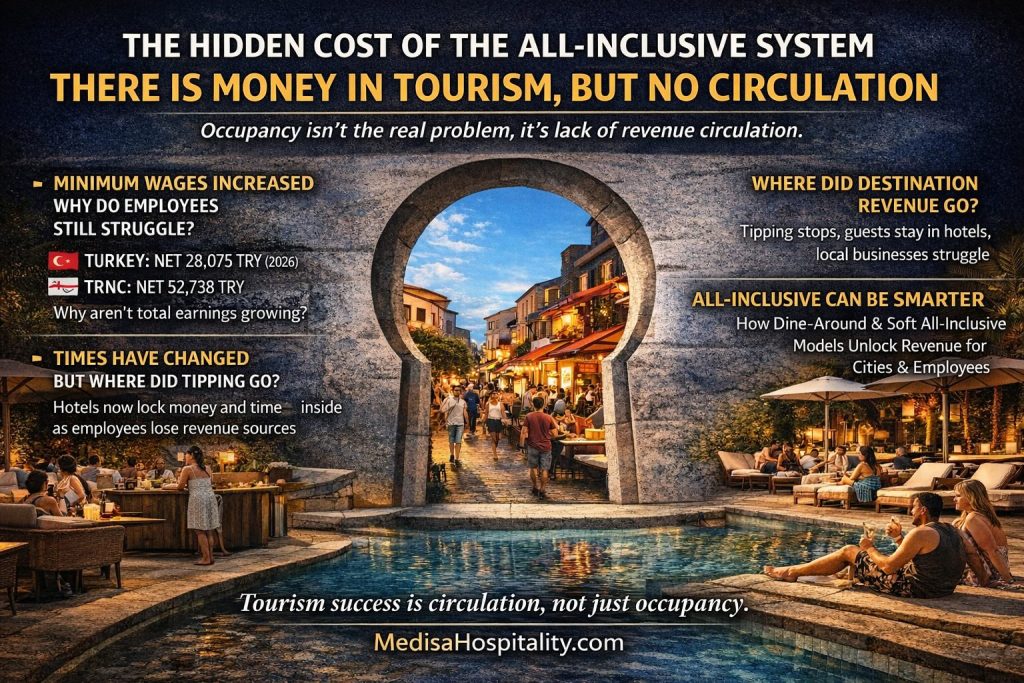
Context (minimum wage figures): The numbers below reflect announced net minimum wage decisions for 2026 and are used here to illustrate the same structural challenge across different markets.
Note: The minimum wage figures below reflect publicly announced net wage decisions for 2026 and are used here to highlight the same structural impact across markets.
-
Turkey (2026 minimum wage): Net 28,075 TRY (27% increase)
-
TRNC (new minimum wage): Net 52,738 TRY (18.39% increase)
Different levels, same reality: when tipping and extra income collapse, total income growth stalls, while rent, food, and transport costs continue rising.
Hotels Are Not Automatically Winning Either
This is important: hotels are not “guaranteed winners” in this model.
Currency pressure, imported input dependency, energy costs, and labor expenses are putting profitability under strain. In many markets, all-inclusive isn’t a luxury choice — it’s a defensive pricing structure that helps hotels remain competitive and forecast costs.
However, when all-inclusive is designed without destination integration, it creates a longer-term risk:
-
Lower employee motivation and retention
-
Pressure on service quality
-
Weak destination experience (repeat intent drops)
-
A destination that looks “busy,” but feels economically stagnant
- Learn more about designing sustainable revenue models and destination-led hospitality strategy via our IR Strategy & Revenue Design service
The Solution Is Not Abandoning All-Inclusive — It’s Making It Smarter
All-inclusive will remain necessary in certain segments. The opportunity is to evolve the model into a hybrid system that improves guest satisfaction while restoring revenue circulation.
1) Dine-Around / City Integration (fastest high-impact lever)
Include 1–2 partner restaurant dinners per week, or provide external spending credits. Make “going out” part of the product — not an afterthought.
2) Soft All-Inclusive
Keep core inclusions, but price premium dining, premium beverages, and signature experiences separately. This reopens healthy spending channels without harming value perception.
3) Official “Outside Time Windows”
Design daily programming with deliberate gaps (e.g., 17:00–20:00) so leaving the resort becomes normal, easy, and frictionless.
4) Service Charge With Transparent Distribution
Where culturally appropriate, introduce a structured service charge model with clear, fair distribution to support staff income and service quality.
5) Reposition Front Office & Concierge as Destination Connectors
Concierge should not be passive. It should actively package local dining, culture, transfers, short experiences, and events — helping guests discover the destination and supporting the wider economy.
(Optional internal link for your site: add a line like this and link it to your relevant service page)
Learn more about designing sustainable revenue models and destination-led hospitality strategies: [INSERT INTERNAL LINK HERE]
Conclusion: Tourism Success Is Revenue Circulation, Not Occupancy
Occupancy can look strong while the destination economy weakens. The difference is circulation — where guest time goes, where guest money goes, and whether the destination ecosystem shares in the value created.
All-inclusive, in its current form, often concentrates spending and time inside hotel walls. That reduces tipping, limits local business revenue, and traps employees in fixed wages.
Tourism has money — but when circulation breaks, everyone feels it.
Medisa Hospitality
Insights on sustainable hospitality models, destination integration, and smart tourism economics.
If you’d like a practical Dine-Around pilot or a Soft All-Inclusive redesign for your property or destination, contact Medisa Hospitality