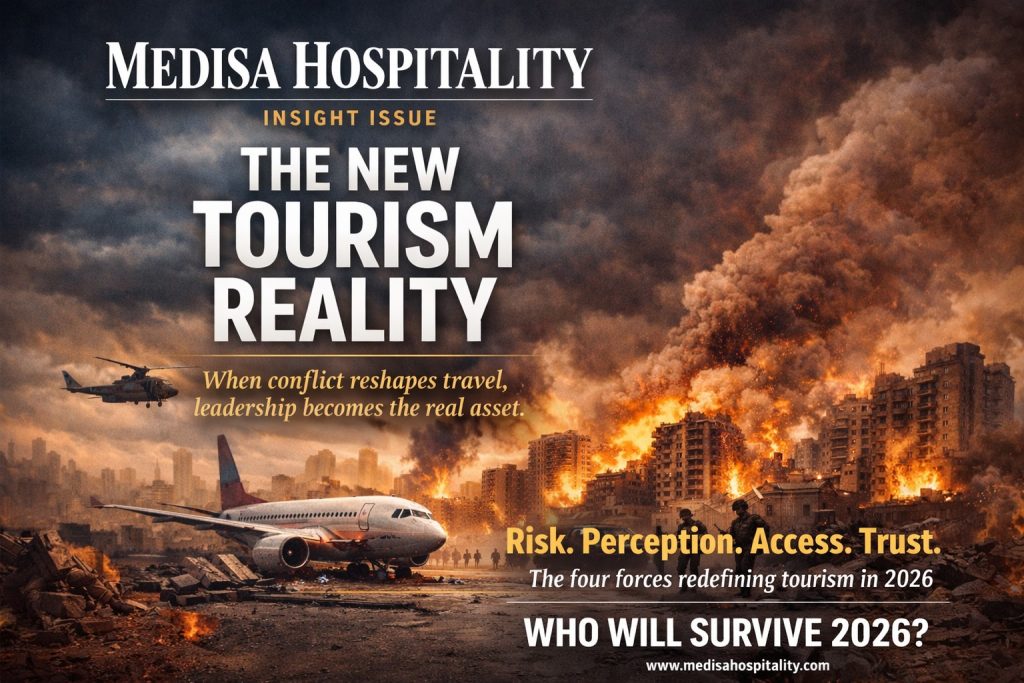
As we move through 2026, the tourism industry is entering a new phase. The key question is no longer only how to generate demand, increase occupancy, or attract new markets. The real question is this:
How prepared are we to manage uncertainty?
The growing tension around the Iran–Israel–U.S. axis is not only a geopolitical issue. For tourism leaders, hotel operators, destination managers, and travel brands, it is a reminder that modern tourism is deeply connected to global risk. War, regional instability, disrupted air access, rising operational costs, and changing traveler perception are no longer distant concerns. They are now part of the business environment.
In this new reality, success in tourism will not be defined only by how well a company performs in stable times. It will be defined by how well it responds when conditions suddenly change.
The first impact of war is not always physical — it is psychological
Tourism is built on confidence.
Before travelers buy a room, a package, or a flight, they buy a sense of safety and predictability.
That is why the first impact of conflict is often not seen at the destination itself. It appears in traveler perception, booking hesitation, market uncertainty, and a shift in decision-making. A destination may be geographically unaffected, but still feel the consequences if international audiences begin to see the broader region as unstable.
This is where many tourism businesses make a critical mistake. They focus only on whether the crisis is physically close, instead of asking how it is being perceived by the market.
In tourism, perception can move faster than reality. And once confidence weakens, demand becomes fragile.
Destinations do not sell rooms first — they sell access
A strong tourism product depends on one basic condition: accessibility.
In periods of regional tension, air routes, airline confidence, insurance conditions, transfer planning, and connection networks all become part of the tourism equation. The issue is not only whether people want to travel. It is whether they can travel easily, predictably, and with confidence.
This means tourism leaders must stop thinking only in terms of promotion and start thinking more seriously about continuity.
Which source markets remain reliable in a volatile environment?
Which transport routes can be protected or replaced?
How quickly can alternative access strategies be activated?
In 2026, resilience is no longer just an operational strength. It is a commercial advantage.
Crisis management is no longer a separate function
For many years, crisis management was treated as something secondary — a protocol to open only when needed.
That mindset no longer works.
Today, crisis readiness must sit at the center of tourism strategy. It is not a side department. It is part of leadership itself.
A strong hotel, destination brand, or travel business must now be built around:
-
scenario planning
-
rapid internal decision-making
-
transparent guest communication
-
flexible cancellation and rebooking structures
-
diversified source markets
-
operational back-up systems
-
financial discipline under pressure
In other words, tourism leadership in 2026 is no longer only about growth. It is about preparedness, adaptability, and trust.
Occupancy alone is no longer the measure of success
In periods of geopolitical tension, many businesses still look at one headline metric: occupancy.
But occupancy alone can be misleading.
A hotel may fill rooms and still lose margin. A destination may maintain arrivals while facing deeper pressure on pricing, cost structures, and operational quality. A business may appear busy, yet carry serious hidden vulnerability in its cash flow, cancellation exposure, supplier costs, or market dependency.
This is why real leadership today must go beyond revenue generation. It must protect financial health.
The real test is not only whether demand continues. The real test is whether the business can preserve margin, maintain confidence, control volatility, and stay operationally disciplined under pressure.
That is the difference between activity and resilience.
Leadership in tourism is being redefined
The tourism leader of 2026 will not be the loudest voice in the market.
It will not be the person with the biggest campaign, the most optimistic message, or the most visible brand presence.
The strongest leader in this environment will be the one who can remain calm under pressure, communicate clearly, make fast decisions, and build systems that continue to function when uncertainty rises.
This applies to hotel general managers, destination leaders, investors, DMCs, tourism boards, and hospitality brands alike.
True leadership today is not about controlling every detail personally.
It is about building teams, systems, and structures that can operate with clarity and confidence — even when external conditions become unstable.
A new strategic model for tourism
The old tourism model was built on visibility, volume, and seasonality.
The new model must be built on:
Trust. Access. Agility. Resilience.
These are no longer soft concepts. They are strategic assets.
The Iran–Israel–U.S. crisis is simply one example of a much larger truth: the tourism industry now operates in a world where geopolitical shocks can quickly reshape travel behavior, operating costs, and market confidence.
That is why 2026 should be seen as a turning point.
The tourism brands that will stand out are not necessarily the ones that market themselves most aggressively. They are the ones that prepare most intelligently.
Conclusion
Tourism is no longer just about hospitality.
It is about confidence management, continuity planning, operational resilience, and leadership under uncertainty.
In a world shaped by war, regional tension, and fragile traveler sentiment, preparedness is no longer optional. It is a defining business principle.
The winners of 2026 will not simply be those who attract the most attention.
They will be those who build the strongest systems, respond the fastest, and protect trust when the market feels uncertain.
Because in the new tourism reality, success is not measured only by how well you perform in good times.
It is measured by how well you lead in difficult ones.