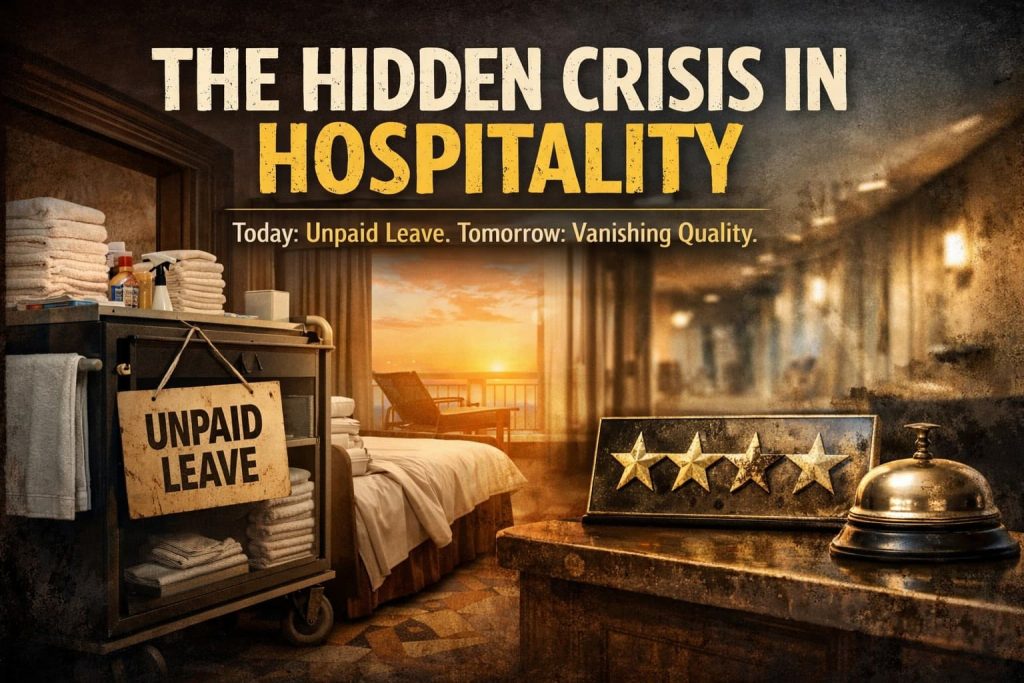
The staff placed on unpaid leave today become the quality that does not return tomorrow.
This is not just a cost decision — it is the beginning of brand erosion.
What Do Hotel Closures in the Eastern Mediterranean Really Tell Us?
The staff placed on unpaid leave today become the quality that does not return tomorrow.
A concerning pattern has been emerging across the Eastern Mediterranean.
Some hotels are delaying their seasonal openings, some are scaling down operations, and others are placing employees on unpaid leave.
At first glance, these developments may be explained by regional tensions, demand fluctuations, or seasonal pressure.
But on closer inspection, this is not simply a demand issue.
It is a clear sign of how short-term cost-cutting decisions in tourism can gradually erode long-term brand value.
The Hidden Cost: The Weakening of Human Infrastructure
One of the biggest misconceptions in tourism is treating human resources purely as a cost item.
The truth is far more straightforward:
The real value of a hotel, resort, or destination lies in its human infrastructure.
And this is not limited to a few departments.
From front office and housekeeping to food and beverage, technical operations, sales teams, and management, the entire organisational structure forms the foundation of both guest experience and brand perception.
Because guests do not experience a brand only through advertising.
They experience it in the way they are welcomed, the quality of service they receive, the consistency of the operation, the way problems are handled, and the feeling they leave with at the end of their stay.
For this reason, every employee pushed out of the system or placed on unpaid leave represents more than a reduced headcount. It also means:
-
weaker service standards,
-
fading institutional memory,
-
reduced operational consistency, and
-
declining brand perception.
Service Quality Erodes Quietly
Staff shortages do not always appear immediately on a financial statement.
But their effects are quickly felt across operations:
-
service and response times become longer,
-
experience standards begin to slip,
-
guest satisfaction weakens, and
-
online reputation starts to decline.
This process is not linear; it creates a multiplier effect.
Because in tourism, losing one guest is not merely the loss of one booking.
It often means losing future demand as well.
A New Risk in the Eastern Mediterranean: The Single-Dimension Revenue Model
In parts of the region, a troubling shift is becoming visible:
-
the accommodation experience is pushed into the background,
-
service quality is “optimised” — which often means reduced,
-
and revenue becomes dependent on a narrow set of segments.
This approach may generate short-term cash flow.
But over time, it weakens the entire business model:
-
total revenue structure becomes more fragile,
-
ancillary revenues decline, including F&B, wellness, and experience-based income,
-
and the destination loses diversity and resilience.
The result is clear:
The economic model narrows while the brand slowly erodes.
Brand Erosion: The Most Critical Breaking Point
Once a hotel or destination begins to create the following perception:
“Service is weak, the experience is limited, and quality is inconsistent,”
this is no longer simply an operational issue.
It becomes a strategic brand crisis.
And the consequences are serious:
-
loss of higher-value guests,
-
weakening of family and experience-driven tourism,
-
retreat of the MICE and events segment,
-
and declining international brand value.
At that point, recovery becomes both costly and time-consuming.
The Real Question: Is It a Crisis, or a Structural Model Problem?
Many of today’s contractions are explained through external factors:
-
regional instability,
-
shifts in demand,
-
or seasonal effects.
But the more important question is this:
Is the real issue demand — or is it the business model itself?
If, within a business:
-
the first item to be cut is human capital,
-
service quality becomes secondary,
-
and short-term cash flow takes priority over long-term guest experience,
then the problem is not simply a crisis.
It is a sign of an unsustainable model.
The Solution: A Human-Centred and Balanced Tourism Model
For a tourism economy to remain sustainable:
-
people must be seen not as a cost, but as a strategic investment,
-
service standards must be protected and continuously improved,
-
the experience economy must be strengthened,
-
revenue streams must be diversified,
-
and employee engagement and training must become a priority.
Because the simple truth is this:
In tourism, quality is not created by buildings. It is created by people.
Conclusion
The staff placed on unpaid leave today become the quality that does not return tomorrow.
This is not merely a cost decision; it is the beginning of brand erosion.
The Eastern Mediterranean holds enormous potential.
But that potential can only become sustainable long-term value through the right operating model and a strong human foundation.
Otherwise, the short-term decisions made today will become tomorrow’s brand loss.