In times of geopolitical uncertainty, tourism does not decline first because of physical risk — it declines because confidence shifts faster than reality. What shapes tourism demand today is not only what happens on the ground, but how global perception is formed around it.
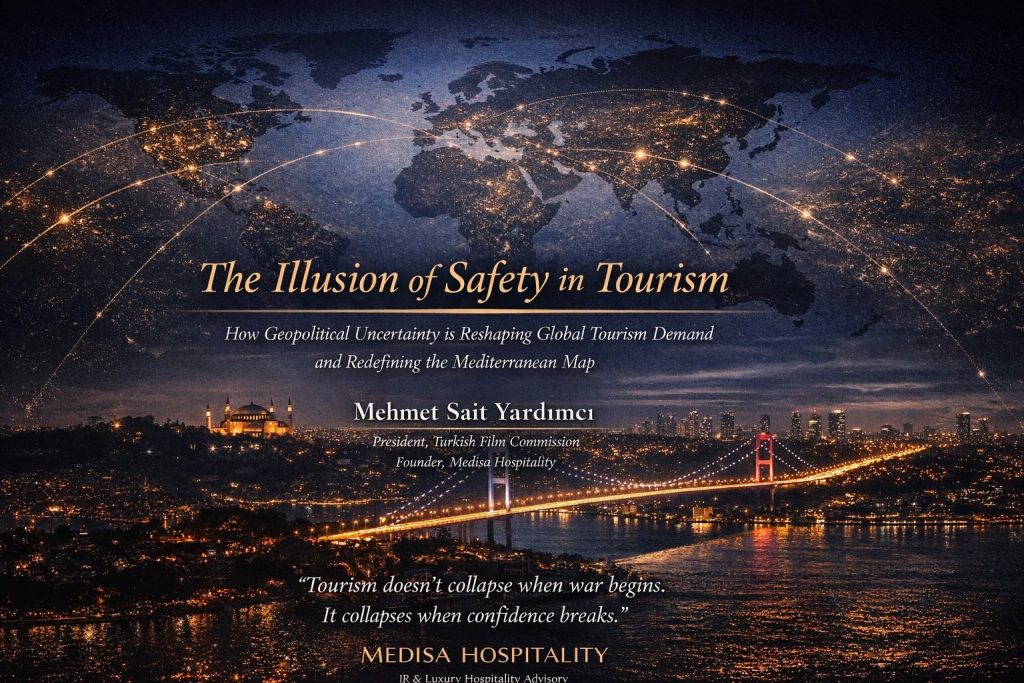
The Illusion of Safety in Tourism
How Geopolitical Uncertainty is Reshaping Global Tourism Demand and Redefining the Mediterranean Map
In times of geopolitical uncertainty, tourism does not decline first because of physical risk — it declines because confidence shifts faster than reality.
Rising geopolitical tension in the Middle East cannot be assessed solely through the lens of war, missiles, airspace disruptions, or oil prices. The real pressure point for tourism is often not the physical threat itself, but the erosion of perceived safety.
Tourism reacts to perception before it reacts to facts. Booking decisions are shaped less by on-the-ground realities and more by media narratives, international headlines, travel advisories, air connectivity, insurance attitudes, and consumer psychology. The key question is no longer simply whether a country is safe, but whether it is perceived to be safe.
1. The Real Battlefield: Perception, Not Geography
History has shown this repeatedly:
Destinations do not lose visitors merely because they are geographically close to conflict.
They lose visitors when they are perceived to be part of the conflict zone.
This is the critical threshold for Türkiye.
A country may be geographically near risk, yet still be positioned as operationally safe, accessible, and fully functional. The opposite is equally possible: conditions on the ground may remain stable, but once perception deteriorates, demand starts to weaken.
Tourism collapses in perception first, and in numbers later.
2. The Scenarios Are Valid — But Incomplete
A projected decline of 10% to 40% in demand may be realistic under different geopolitical scenarios. However, those figures are still linear models applied to a fundamentally non-linear industry.
Tourism does not respond proportionally:
-
A 10% decline is manageable
-
A 25% decline creates systemic pressure
-
A 40%+ decline can trigger structural disruption: rate erosion, cash flow stress, and employment contraction
But the deeper truth is this:
👉 Demand does not disappear. It relocates.
If Türkiye weakens in perception:
-
Spain gains
-
Greece absorbs redirected bookings
-
Italy captures premium demand
This is not simply a tourism loss.
It is a global redistribution of demand.
3. The Mediterranean Is Entering the Era of the “Safety Premium”
Destinations are no longer selling sun, sea, and hospitality alone.
They are increasingly selling stability.
-
Spain is monetising predictability
-
Greece is benefiting from distance perception
-
Italy is leveraging brand resilience
Meanwhile, the Eastern Mediterranean faces:
-
growing discount pressure
-
shorter booking windows
-
stronger dependence on last-minute demand
This is not a temporary fluctuation.
It is a repositioning of the Mediterranean tourism map.
4. Türkiye Still Has a Strategic Window — If It Is Managed Properly
Türkiye still holds powerful structural advantages:
-
strong aviation and hub connectivity
-
a diverse tourism portfolio: culture, coast, city, and MICE
-
compelling price-performance value
-
operational flexibility and resilience
If positioned correctly, Türkiye can:
✔ absorb overflow demand from overheated Western markets
✔ present itself as a zone of controlled stability
✔ convert crisis into market share
But none of this happens automatically.
Advantages alone do not sell. Narrative does.
5. The Biggest Mistake: Competing on Price
In times of uncertainty, many destinations make the same mistake:
👉 they discount instead of repositioning
Price cuts do not restore confidence.
They signal weakness.
Once a destination is perceived as a bargain option rather than a value-driven one, recovery becomes long and expensive. Premium perception, once lost, is not rebuilt in a single season.
6. This Is Not a Marketing Problem — It Is a Confidence Engineering Problem
What the sector is facing is not merely a communications challenge.
It is a confidence engineering challenge.
The priorities should be clear:
1. Narrative Control
Türkiye must be consistently positioned as operational, accessible, and stable
2. Air Connectivity Protection
Flight continuity is one of the strongest symbols of perceived normalcy
3. Market Diversification
Overdependence on highly reactive source markets increases fragility
4. Premium Position Protection
Do not sell fear with discounts. Protect value
5. Speed of Communication
In times of uncertainty, silence is filled by anxiety
7. The Silent Strategic Asset: Cinema, Television, and the Visual Economy of Perception
Tourism today is no longer shaped only by airlines, hotels, and tour operators.
It is also shaped by screens.
Films, television series, documentaries, streaming platforms, and international productions now play a central role in how countries are imagined globally. A destination’s visual identity increasingly influences its tourism value, investor confidence, and international appeal.
A country is often purchased emotionally before it is booked commercially.
Destinations that appear:
-
vibrant
-
safe
-
cinematic
-
culturally alive
-
internationally active
are more likely to attract not only visitors, but also investors, events, creative collaborations, and global attention.
This is why cinema and television should no longer be seen merely as promotional support tools. They are part of a country’s strategic soft power architecture.
For Türkiye, this matters deeply.
The right international productions, visual storytelling, and screen exposure can reinforce an image of Türkiye as:
-
functional
-
welcoming
-
culturally rich
-
globally connected
-
open for business and production
In certain periods, a globally watched series or a major international production can do more for destination confidence than a traditional advertising campaign ever could.
Conclusion
Tourism is not fragile.
But it is highly sensitive to perception.
Crises do not necessarily destroy destinations.
They re-rank them.
The winners of 2026 will not simply be the safest countries.
They will be the countries perceived to be the most stable, accessible, and reliable.
And perception, unlike geography, is not fixed.
It can be shaped, managed, and strategically converted into advantage.
Medisa Hospitality Perspective
Those who understand risk survive.
Those who manage perception win the market.